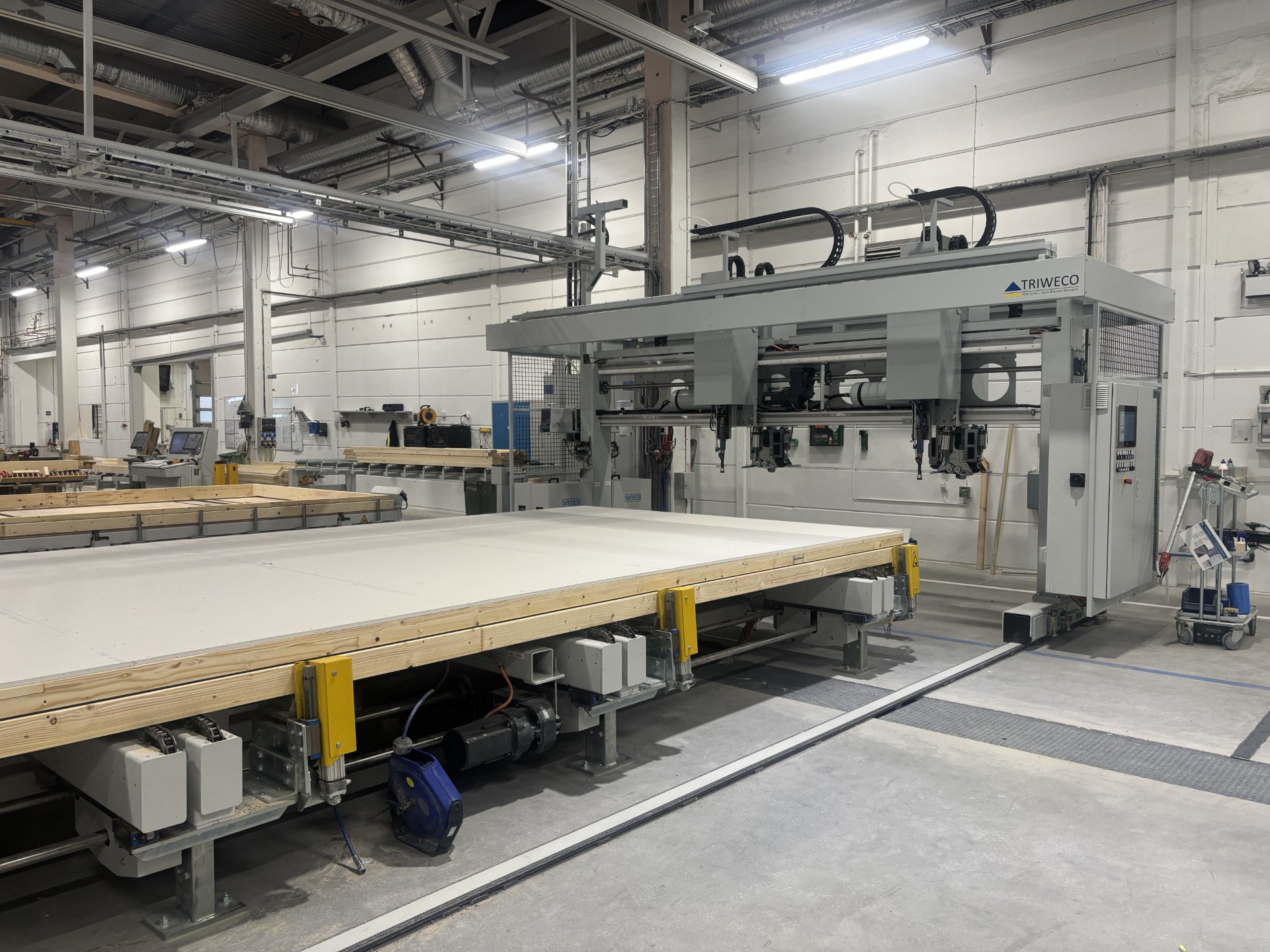
High-Performing Machines Vs. Factory-Level Throughput
February 24, 2026
In industrialized construction, automation discussions often start with machine speed. Panels per hour. Line speed. Cycle time per station.
While these metrics are easy to communicate and compare, and while our machines are fast (running at a speed of 3 nails per second, or one screw per 5 seconds), this rarely tells the full story. In fact, some of the fastest machines on the market are installed in factories that still struggle to increase overall output.
The reason is simple: machine speed is not the same as factory throughput.
A prefab factory is a system — not a collection of independent machines and siloed software. Increasing speed at one station often shifts bottlenecks elsewhere and creates work-in-progress buildup, or introduces variability that downstream processes can’t absorb. The result is a line that looks impressive on paper but underperforms in reality.
True factory performance is determined by:
- How well processes are balanced across the full value stream
- How consistently materials, data, and people flow
- How quickly the factory stabilizes after changes or volume increases
- How reliably production targets are met week after week
- How well data flows between systems and machines
Offsite manufacturers often invest in fast equipment but are left to integrate systems, redesign workflows, and manage production risk themselves.
Thinking in factory outcomes changes the conversation.
Instead of asking:
- How fast is this machine?
The more important questions are:
- How many houses can this factory produce per year?
- How do we secure a stable pipeline of orders for this capacity?
- How stable is output when product mix changes?
At Triweco, we see great success when automation starts with these questions — not only with machines. Through design reviews, feasibility studies, production modelling, and integrated control software, the focus is on predictable factory-level outcomes, not isolated performance metrics.
Machines are important. But without system-level design, orchestration, digital oversight and data-driven decision-making, speed alone rarely delivers scale.
The factories that win are not the fastest at one station — they are the most reliable as a system.
Contact us to discuss how we can help you combine system-level design with the speed and quality of Triweco machinery.