The Value of a Fully Connected Factory
May 5, 2026
Why Prefab Manufacturers Need a “Control Tower”
As industrialized construction scales, prefab manufacturers have invested heavily in advanced machinery, automation, and design tools. Yet a critical gap remains - one that continues to limit productivity, quality, and scalability.
The factory itself is still not fully connected.
This means that your design data lacks context on the shop floor. Therefore, new designs mean hours of set-up time in large factories since machines, robots and operators typically operate in isolated or fragmented systems. Production visibility is based on limited snapshots rather than real-time data.
The result is familiar: inefficiencies, quality variation, and difficulty scaling.
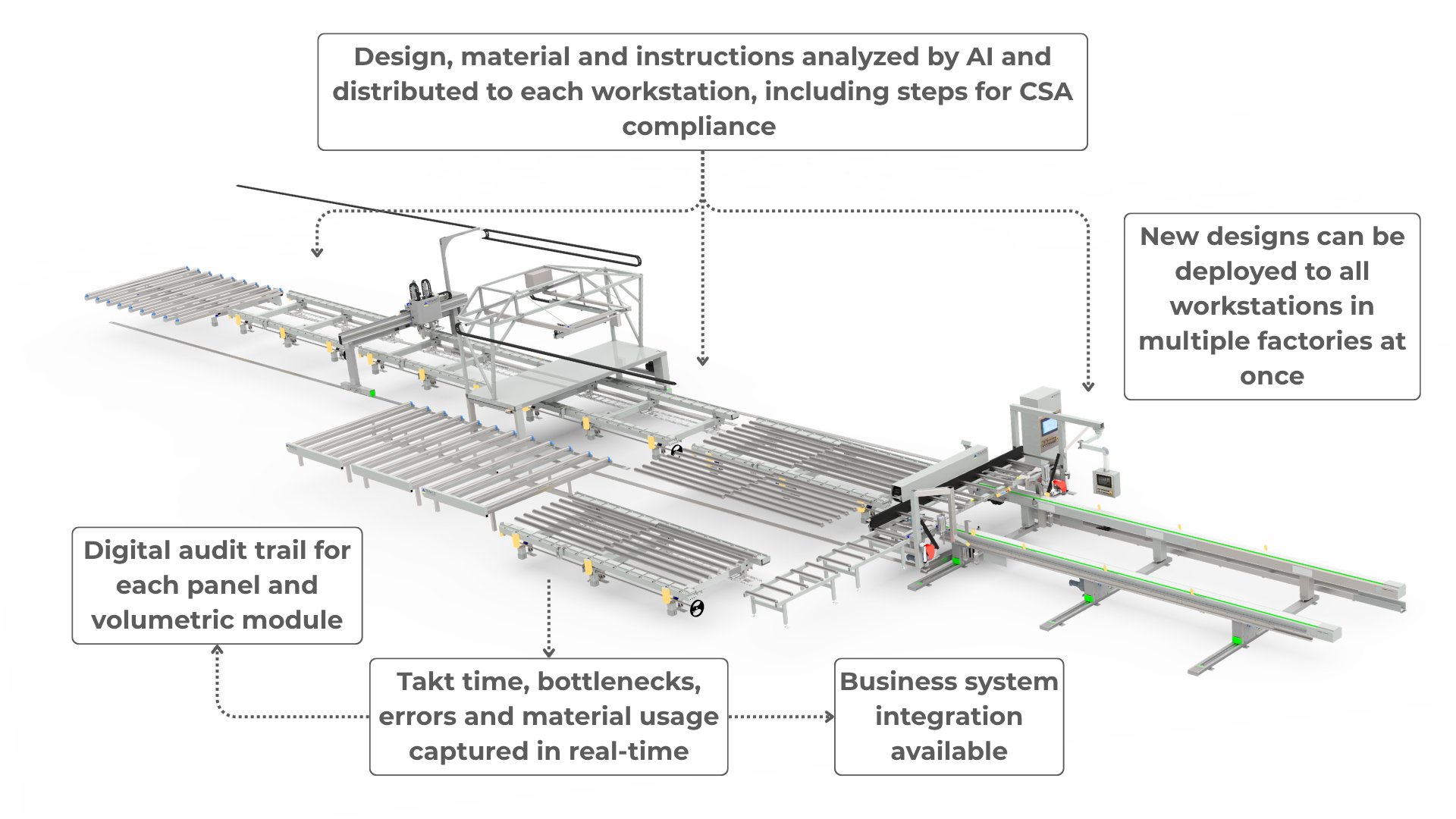
In our conversations, we increasingly hear manufacturers who are finding this problem unacceptable in 2026. This is why we developed our platform for the connected factory - “Control Tower.” This is a central AI-native operational layer that connects design, machines, operators, materials, and production data into one unified system. It creates a single source of truth across the entire factory and can integrate with your ERP, procurement and other key systems in your prefab business.
This shift is being driven by three forces.
- First, increasing complexity. Modern factories handle multiple product variants, workflows, and dependencies, making coordination without a connected system increasingly difficult.
- Second, traceability is becoming essential. Manufacturers are now expected to know exactly what material was used, how a panel was produced, and whether every step was completed correctly.
- Third, scaling exposes weaknesses. As volume grows, disconnected systems quickly lead to loss of control.
By leveraging a local LLM that automatically reads the geometry in your CAD, understands the construction logic and the sequence in which panels are built, we can orchestrate the factory floor and, in a matter of minutes, bring your house design from paper product to operator and machine instructions for production.
While each station builds your product, we mine the data which means you receive relevant insights like takt times, bottlenecks, and completed CSA checkpoints so that quick continuous improvements can be made.
This level of visibility changes how factories operate. Instead of reacting to problems after they occur, teams can monitor performance in real time and ensure consistent quality.
A fully connected factory also enables what is often called a digital thread. Every part and panel is tracked through production, linked to materials, processes, and timestamps. By the time a home is completed, its full production history is available and verifiable.
As the industry evolves, success will depend not just on better machines, but on smarter factories using the latest AI-driven technology —factories that alleviate error-prone and time-consuming work from humans, that track data efficiently and continuously improve operations based on real insights.
In this reality, software is no longer optional. It is the operating system of the factory.
And the question is no longer whether it’s needed—but how long manufacturers can operate without it.